Journal guide
Before ordering a custom portrait or pet figurine, it helps to know what to ask and which details to check. This guide walks you through five practical questions to help you compare makers and clarify what your order includes. For available finishes, dimensions and current costs, see Linxi’s product and pricing guide.
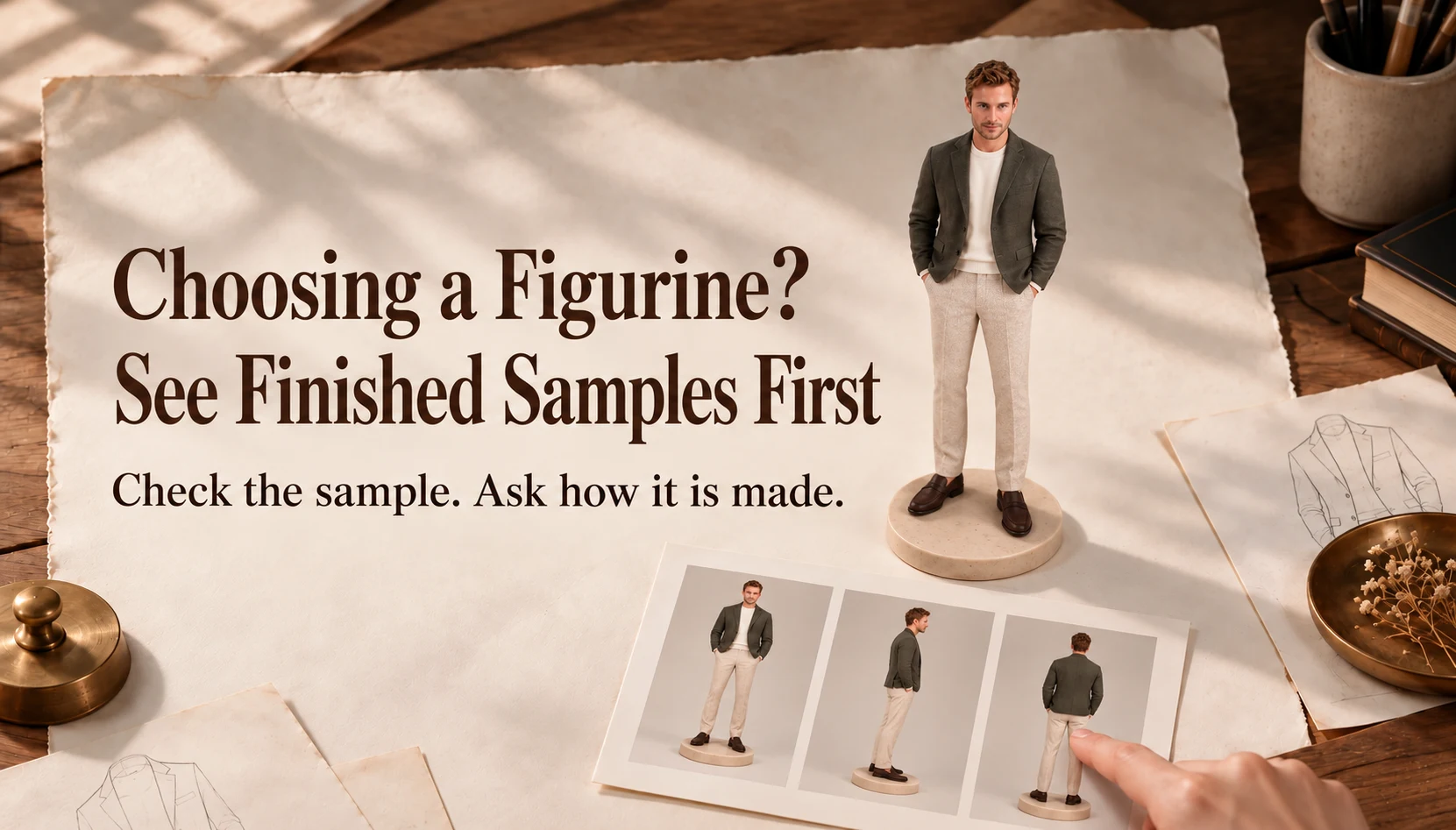
When choosing a maker for a custom portrait or pet figurine, look for three things: a clear explanation of the production process, examples of similar finished pieces, and a written description of exactly what you will receive. The following five questions can help you compare different makers.
First, here is what the three methods compared in this article mean:
· FDM: Heated plastic filament is deposited layer by layer to build the shape. The finished print can also be painted afterward.
· Hand-painted resin figurines: In this article, this specifically means printing an unpainted model in white photosensitive resin, refining its surface, and then painting it by hand.
· Full-color photopolymer resin printing: Photosensitive resin is cured with light to form the model, while its colors are produced during printing. In this article, “full-color” refers only to this type of process.
Hand-painting is not limited to white resin: FDM prints can be hand-painted too. Look beyond the process name and ask: What material is used? Does the print need sanding, filling, assembly, or other finishing work?
Linxi’s full-color photopolymer printing process produces colors during printing, without manual hand-painting. For details, see their printing guide.
Choose samples that are close to the piece you want; they will give you a more useful reference. For example, if you want a small pet figurine, look at finished pet figurines of the same size rather than imagining the result from a large portrait sample.
Ask the maker for the length, width, and height, and check whether those measurements include the base. Also consider the complexity of the pose, small accessories, and patterns. Even if two figurines have the same height, the size of the main subject and the difficulty of reproducing its details can vary considerably.
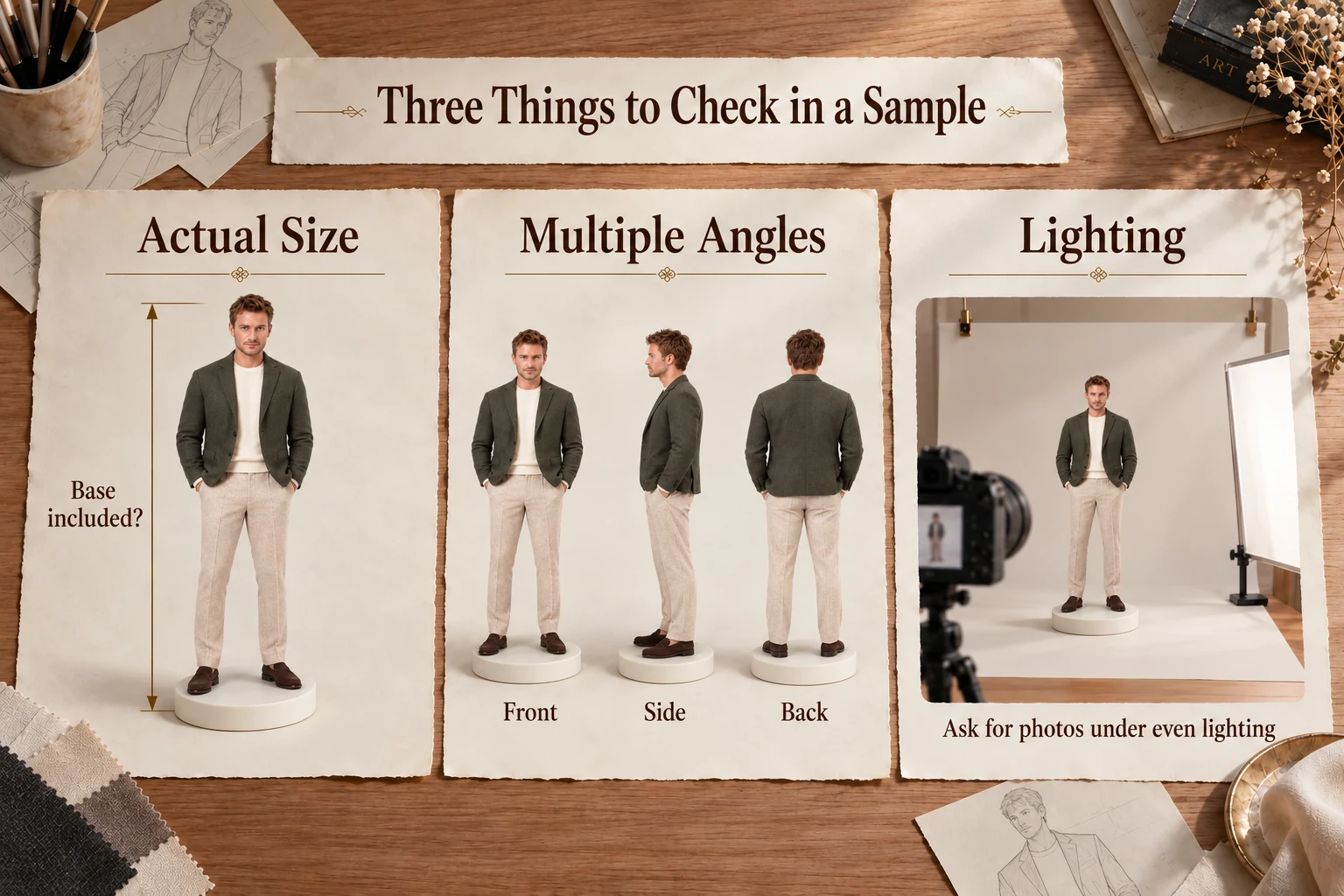
Also ask: “Will my order use the same production process and surface finish as this sample?” Specially prepared display samples may receive more attention than standard pieces, so they may not reflect the usual level of finish.
If an exact match is not available, that is fine. Look for the closest examples in style and size, and ask the maker to clarify anything you cannot assess.
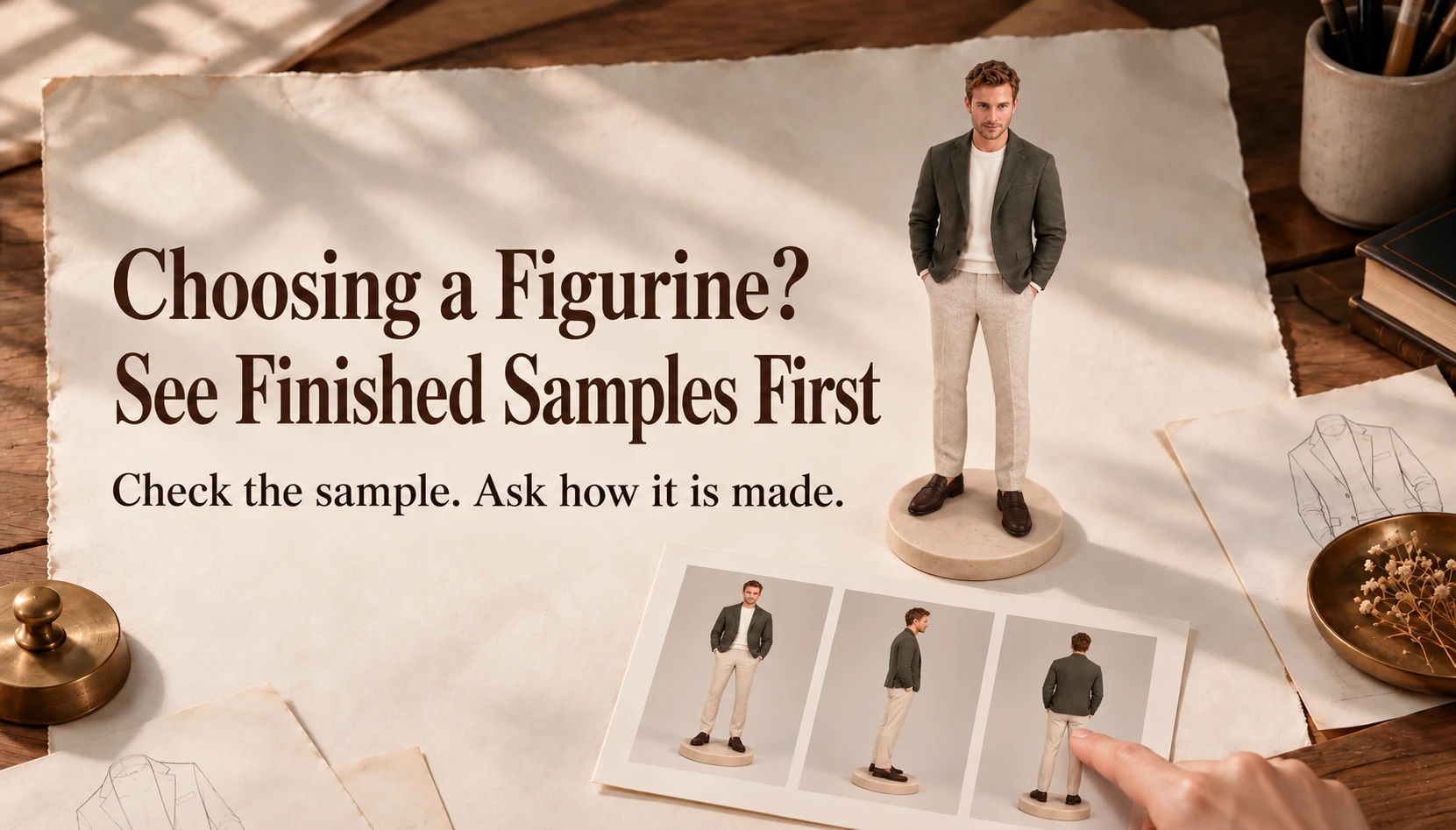
You can ask directly: “Please send front, side, and rear views of this finished piece, along with close-ups and its dimensions.” Confirm that the images are photographs of an actual finished object, not computer-generated renders.
Use the overall views to assess the shape. Check areas hidden from the front, including the sides and back, and examine the details that matter most to you. If possible, ask for a video showing the model from all sides.
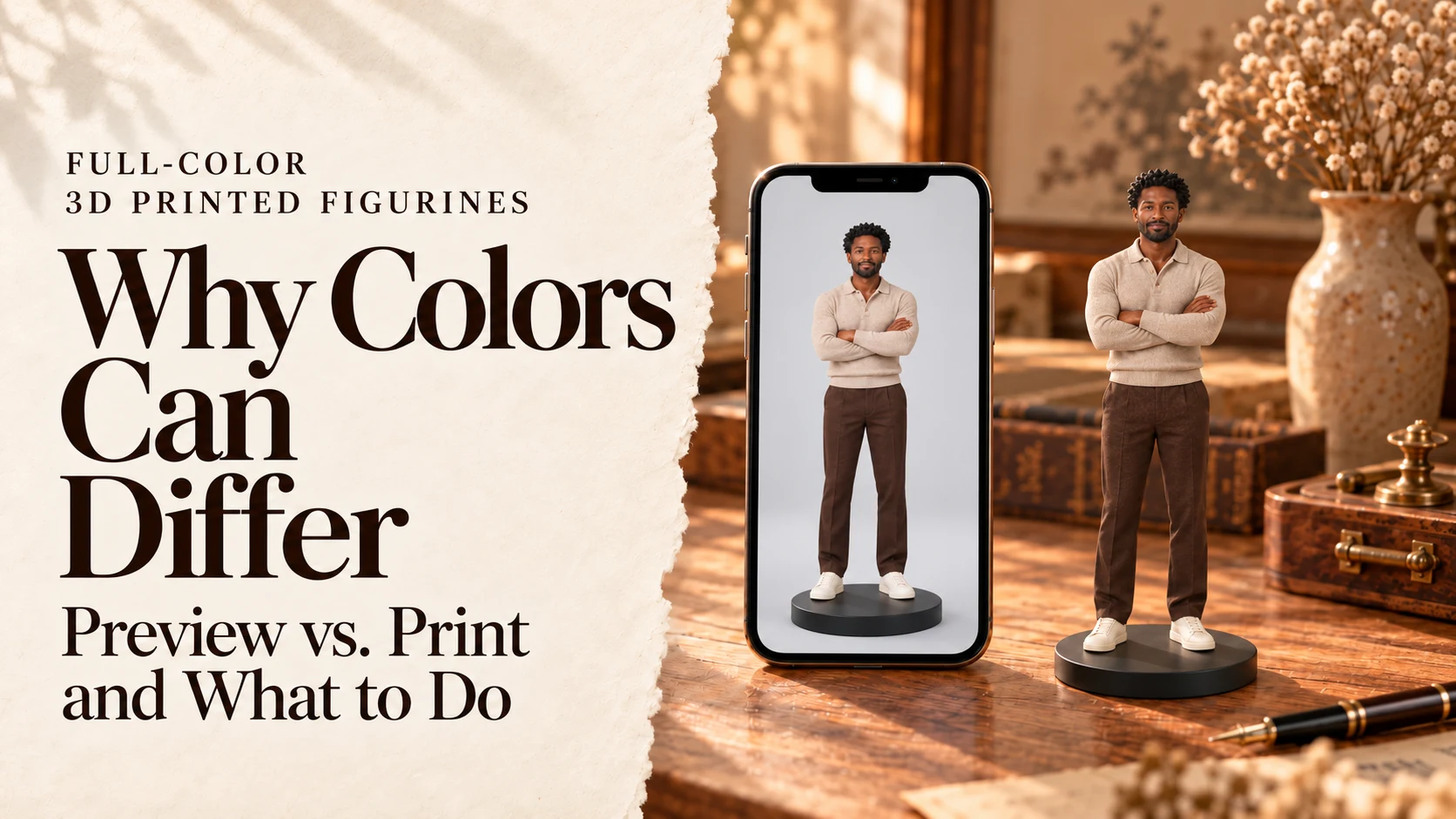
Pay attention to camera distance, magnification, angle, and lighting. A close-up does not show how the entire figurine will look from a normal viewing distance. Camera settings and editing can change colors, shadows, and apparent sharpness.[2] Ask: “Have these photos had their colors adjusted or surfaces retouched? Could you provide another set taken under even lighting?”
Assess the sample’s shape, color, and surface finish in the context of the process used to make it.
For FDM prints, focus on layer lines. Most unfinished FDM prints show lines where the layers build up. Their visibility depends on the printer, material, settings, print orientation, and subsequent sanding. The process name alone cannot tell you how smooth the finished piece will be.
Ask for close-ups of the sides, sloping surfaces, and large curves, and ask: “Has this piece been sanded, filled, or primed? Are those steps included in my order?” When you receive the piece, view it first from its normal display distance, then inspect it closely to decide whether the finish meets your expectations.
For hand-painted white resin, assess both the shape and the paintwork. Ideally, ask for photos of the same piece before and after painting. Use the unpainted model to check contours such as fingers and collars, and the painted version to examine eyes, patterns, and color boundaries. Confirm that your order includes the same hand-painting and surface treatment as the sample.
For full-color photopolymer prints, check both shape and color. Rich patterns do not necessarily mean crisp sculptural detail, and printing colors directly does not mean there will be no layer lines or finishing work. Here too, ask for multiple views and close-ups of a finished piece in the same size.
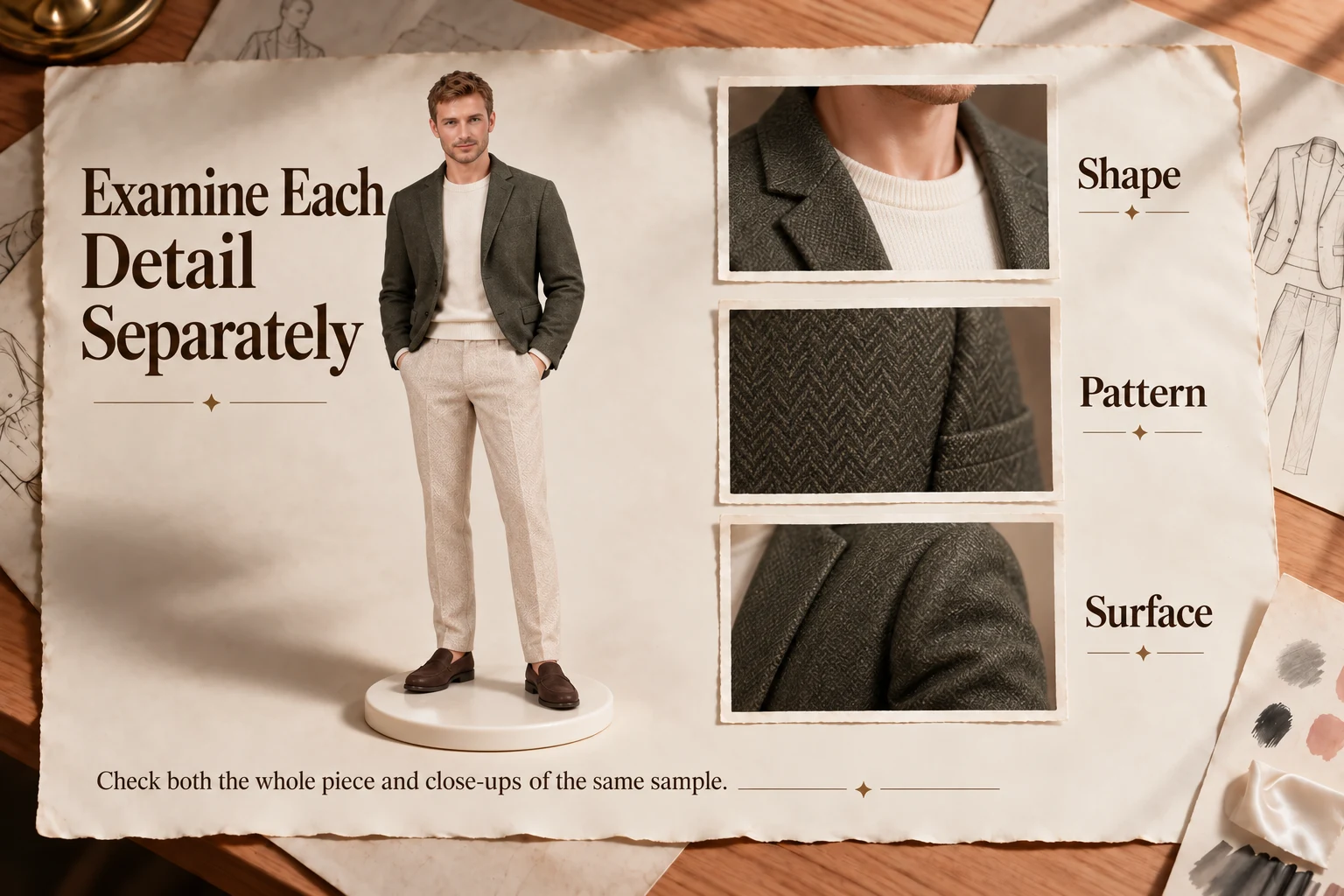
Dark lines in a photo may be grooves or patterns on the object, or simply shadows. Bright spots may also be caused by lighting. If an area is unclear, ask the maker for additional photos of that specific spot and an explanation.
Match the sample’s features to your order requirements and keep a written record. Ask the maker to specify whether the dimensions include the base, which accessories are included, whether you will need to assemble anything, and what level of painting and surface finish you will receive. This helps prevent misunderstandings about what “the same finish” means. Use the checklist below when speaking with makers.
What to compare | What to examine | What to request | Common misconceptions |
Production method | Shape, color, and finishing | Materials and the complete process | FDM and hand-painting cannot be combined |
Sample conditions | Size, subject, angles, and photography conditions | Similar samples, actual dimensions, and editing details | The size in a photo reflects the actual size |
FDM layer lines | Lines on sides, slopes, and curved surfaces | Finished-piece close-ups and finishing details | Layer lines always mean poor quality; all sanding produces the same result |
Hand-painted resin | Unpainted contours and painted patterns | Before-and-after photos of the same piece, if available | A white appearance proves the material and process |
Full-color photopolymer printing | Shape, color, and surface marks | Front, side, rear, and close-up photos of the same finished piece | Printing colors directly eliminates finishing work |
What you receive | Base, accessories, assembly, and surface finish | A written list of what is included | Everything shown in the sample is automatically included |
Once you have the answers, how do you choose?
Identify the two or three requirements that matter most to you, then check them against the sample photos and the maker’s answers. Keep the options that meet your needs, set aside those that do not, and ask follow-up questions about anything that remains unclear.
For example, if a particular marking on your pet is your priority, first look for photos showing that detail on a finished piece of the same size. If you like a particular artist’s hand-painted style, confirm that they have examples of similar work and that your order includes the same treatment. You can use the same approach to assess FDM and full-color photopolymer options.
Equipment, materials, print settings, post-processing, the maker, and size all affect the final result. Choose the specific solution that suits your needs, rather than relying on an impressive-sounding process name.
This guide is intended to help you evaluate a maker’s examples of finished work. For advice on preparing your own reference photos, see our custom figurine photo requirements.
1. Formlabs — FDM, SLA, and SLS Compared
2. Shopify — Ecommerce Photography Guide
3. Stratasys — PolyJet Technology
4. Formlabs — Priming and Painting 3D Prints
These sources explain general concepts. The performance of specific equipment does not represent every production method.